
The most costly mistake buyers make when sourcing materials from China is trusting a supplier’s own quality report instead of an independent inspection before the container is sealed. That single gap accounts for more rejected shipments, delayed projects, and blown budgets than any other. Sourcing building materials from China works well when you control the process, and fails quietly when you assume the factory will.
This guide breaks down the seven mistakes that repeatedly cost international buyers money, why each one happens, and the specific step that prevents it, so your next order arrives on spec, on time, and on budget.
Why Sourcing Materials from China Goes Wrong So Often
Most sourcing failures are not bad luck. They are predictable, and nearly all of them are visible at the factory before the goods ever leave China. The problem is that buyers sitting thousands of kilometers away never see the warning signs in time.
A tolerance drifts mid-production. A certificate does not match the batch. Cartons get crushed on loading day, not in transit. None of these are exotic problems. They are the same handful of failures repeating across projects, and each one traces back to a decision the buyer made early, often without realizing it carried risk.
At JEES Global, a China-based construction material sourcing company, we have logged over 1,200 factory visits and loaded 850+ containers. The mistakes below are the ones we see most, ranked by how much they cost buyers.
Mistake 1: Choosing a Supplier on Price Alone
The lowest quote is rarely the cheapest order. A price that undercuts every other factory usually signals thinner material, a lower-grade coating, or a cost cut you cannot see in a PDF. The saving disappears the moment a shipment is rejected on site.
Price matters, but it only means something when the specification behind it is identical. A quote for 6mm tempered glass and a quote for 5mm glass sold as 6mm will look almost the same on paper and behave very differently on a facade.
What to do instead
- Compare quotes only after locking the exact spec: thickness, grade, finish, and standard.
- Ask for the material certificate and the mill test report, not just a price.
- Request quotations from two to four factories so you can see where a price sits against the real market.
This is exactly why comparing factory versus trading company quotes side by side matters more than chasing the single lowest number.
Mistake 2: Skipping Supplier Verification Before Payment
Never send a deposit to a supplier you have not verified. A polished website, a fast reply, and a professional catalogue prove nothing about whether the company is a real manufacturer, holds a valid export license, or can produce what it promises.
Verification is not paranoia. It is basic procurement discipline. A legitimate Chinese factory will have a business license you can read, a registered scope of business that matches its products, and an export history that stands up to a check.
The minimum you should confirm
- Business license and registered business scope.
- Whether the company is the actual manufacturer or a reseller.
- Export history and the certifications relevant to your market.
Work through a full supplier verification checklist before any money moves, and read the business license carefully so the document actually tells you something.
Mistake 3: Trusting the Factory’s Self-Inspection
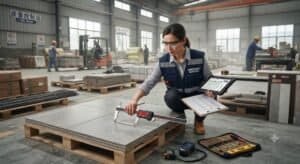
A quality report written by the team being paid for the order is not an inspection. It confirms the factory is comfortable shipping. Nothing more. Independent, on-site inspection against your written spec is the only check that protects you.
The gap here is measurement. Factory self-reports use pass or fail ticks. A real inspection records measured values against every critical dimension, samples randomly across the full production lot, and photographs each defect in context, in daylight, where site conditions will actually expose it.
A proper pre-shipment inspection for construction materials uses AQL sampling under ISO 2859-1 and gives you a clear pass, hold, or reject decision. JEES Global returns that report within 48 hours of the visit, before the container is sealed.
Mistake 4: Writing a Vague Material List or BOQ
A factory can only quote accurately against a clear specification. Ambiguous line items force the supplier to guess, and factories guess in their own favor. “Floor tiles, 600×600” tells a factory almost nothing about grade, finish, water absorption, or slip rating.
Vague documents produce vague quotes, mismatched samples, and the classic dispute where the goods technically match the order but not what you actually wanted. The fix costs nothing but attention.
Make every line quotable
- State size, material grade, finish, thickness, and the applicable standard.
- Specify quantity, required lead time, and destination port.
- Attach drawings or reference images where finish or profile matters.
If your document is not ready to quote, learn how to write a material list or BOQ Chinese factories can price before you send it out.
Mistake 5: Buying From Too Many Separate Suppliers
Every extra supplier adds another price list, another timeline, and another point of failure. Managing eight factories for one project means eight sets of export documents, eight production schedules, and one late supplier able to hold the entire shipment hostage.
Buyers often start direct with individual factories to save on margin, then lose far more in coordination time, part-shipments, and delays. Consolidation is not just convenient. It protects your budget.
This is the core argument for one-stop versus multi-supplier sourcing. A single coordinator matching multiple verified factories and merging everything into one consolidated container removes the failure points without giving up factory-direct pricing.
Mistake 6: Ignoring the Real Landed Cost
The factory price is not what you pay. Landed cost includes freight, insurance, duties, port charges, inspection, and the cost of any rework or rejection. A cheap FOB price with expensive freight and a failed batch can land higher than a dearer, cleaner order.
Buyers who budget only against the ex-works number get surprised at the port. The ones who model the full landed cost make decisions that hold up when the invoices arrive.
Before committing, run the numbers properly with a landed-cost breakdown and decide between full and part container loads based on volume, not habit.
Mistake 7: Treating Alibaba as a Guarantee of Safety
A supplier badge on a marketplace is not verification. Gold Supplier status and trade assurance reduce some risk, but they do not confirm a factory can meet a construction-grade specification or that the samples match production.
Marketplaces are a starting point for finding suppliers, not the finish line for trusting them. The buyers who get burned are the ones who mistake a listing for due diligence.
Understand where the Alibaba scam supplier patterns show up before you treat a marketplace listing as due diligence on a bulk order.
Two More Traps Worth Avoiding
Beyond the seven above, two quieter mistakes catch experienced buyers. The first is relying on emails instead of a proper contract. A written agreement covering specification, quantity, price, lead time, defect standard, and acceptance criteria is what you fall back on when something slips. Verbal or email-only deals leave you with little leverage.
The second is under-protecting custom designs. If you are ordering bespoke doors, cabinetry, or moldings, an NDA and clear ownership of tooling and designs stop a factory reselling your product to others. For construction materials this matters most on custom and branded items.
Both come down to putting the important things in writing before production starts, rather than trusting goodwill across a language and cultural gap where unspoken assumptions rarely survive.
How to Avoid All Seven Mistakes on Your Next Order
Every mistake above shares one root cause: distance. You cannot see the factory floor, read the license, measure the tile, or supervise the loading from another country. The buyers who source successfully from China close that distance, either by building their own team on the ground or by working with a partner who already has one.
| How JEES Global Removes These Risks for You
JEES Global is a China-based sourcing partner built to close exactly these gaps. We match your product to verified factories, run independent quality inspection before the container is sealed, handle export documentation, and consolidate everything into one shipment. With 1,200+ logged factory visits, 850+ containers loaded, and a 98.4% on-time record, you get eyes on the ground without building a team of your own. Send your BOQ or material list and every step runs against your written spec, with photo evidence at each stage. |
Frequently Asked Questions
What is the biggest risk when sourcing building materials from China?
The biggest risk is quality failure discovered after the goods arrive, when rework or replacement is slow and expensive. An independent pre-shipment inspection against your written specification removes most of this risk before the container ships. For a neutral overview of international quality standards, the ISO 9001 quality management framework explains what a credible quality system should include.
How do I verify a Chinese supplier is a real factory and not a middleman?
Check the business license and registered business scope, ask for factory photos or a live video walkthrough, confirm production capacity, and review export history. A reseller’s license scope will focus on trade rather than manufacturing, and a structured verification checklist walks through each step before you pay.
Is it cheaper to buy directly from a Chinese factory?
Direct buying can offer the lowest unit price, but it locks you into one factory’s range, MOQ, and lead time, and leaves you managing verification, inspection, and export alone. Once you add landed cost and coordination time, a sourcing agent, trading company, or direct comparison often tells a different story.
What documents should I get before paying a deposit?
At minimum: the business license, a proforma invoice with clear Incoterms and payment terms, product certifications relevant to your market, and a signed specification the factory agrees to produce against. Reconcile these before any payment leaves your account.
How long does sourcing construction materials from China take?
Standard products typically run 15 to 45 days in production, with custom items taking 30 to 90 days, plus 15 to 35 days of sea freight to most destinations. Building inspection and consolidation into the timeline prevents last-minute surprises.
Source Your Next Project Without the Costly Mistakes
Every one of these mistakes is avoidable with the right process and eyes on the ground in China. If you want your next order verified, inspected, and consolidated into one shipment, send your material list to JEES Global and get sourcing options and a factory quotation comparison built around your project, not a single one-sided quote.