
To source building materials from China, define your specification, find and verify legitimate factories, compare quotations, inspect goods before shipment, and consolidate everything into one export shipment. Done in that order, the process is predictable and protects your budget.
Skip a step and risk climbs fast. This guide walks through every stage of sourcing building materials from China in 2026, from writing a quotable material list to landing a verified, inspected container at your port.
Step 1: Define Exactly What You Need
Sourcing starts with a clear specification, not a supplier search. A factory can only quote accurately against precise requirements. Vague line items force factories to guess, and they guess in their own favor.
Before contacting anyone, turn your project into a document a Chinese factory can price directly. For construction materials that means size, grade, finish, thickness, and the applicable standard for every line, plus quantity, lead time, and destination port.
Build a quotable material list or BOQ
- Specify material grade, dimensions, finish, and standard per line.
- State quantities and your required delivery timeline.
- Attach drawings or reference images where finish or profile matters.
If your list is not ready, learn how to write a material list or BOQ Chinese factories can actually quote before you send anything out. A clear document is the single biggest predictor of a smooth order.
Step 2: Find the Right Factories
Once your spec is ready, the goal is to find factories that genuinely make your product to your standard, not whichever supplier appears first in a marketplace search. China’s manufacturing is regional, and knowing where a product is made saves time.
Where building materials are made in China
| Manufacturing Hub | Known For |
|---|---|
| Foshan / Guangzhou | Tiles, sanitary ware, kitchen, furniture, lighting. |
| Shanghai / Ningbo | Steel structure, machinery, higher-spec industrial goods. |
| Xiamen / Quanzhou | Stone, ceramics, building hardware. |
| Linyi / Tianjin | Timber, boards, bulk construction materials. |
Matching product to region is why the best China manufacturing hubs for building materials matter when you plan sourcing. You can start on Alibaba, but treat it as a directory, not a guarantee. Weigh Alibaba versus a China sourcing company for bulk orders.
Step 3: Verify Every Supplier Before You Pay
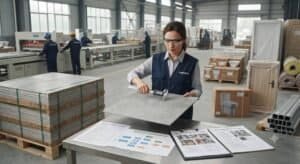
Never send a deposit to an unverified supplier. A professional website and fast replies prove nothing about whether a company is a real manufacturer with a valid export license and the capacity to deliver.
Verification separates factories from resellers and legitimate businesses from fronts. It is the step that prevents the most expensive mistake in sourcing: paying a supplier who cannot deliver.
The verification essentials
- Read the business license and check the registered business scope.
- Confirm the company manufactures rather than resells.
- Review export history and market-relevant certifications.
- Request factory photos or a live video walkthrough.
Work through a supplier verification checklist, learn how to read a Chinese business license, and understand how to tell a factory from a trading company. Watch for Alibaba scam supplier patterns throughout.
Step 4: Compare Quotations Properly
Only compare quotes after locking an identical specification. A price for the exact grade you need and a price for a cheaper substitute sold as the same thing will look almost identical on paper and behave very differently on site.
Request quotations from two to four verified factories. Comparing side by side shows you where a price sits against the real market and gives you leverage on MOQ, lead time, and payment terms. A single quote tells you nothing about whether it is fair.
Look beyond unit price to the full landed cost of building materials from China, including freight, duties, and inspection, before deciding.
Step 5: Order Samples and Confirm Production
For most categories, approve a factory sample before committing to full production. A sample confirms the factory understood your spec and can hit it. Skipping this step is how buyers end up with goods that technically match the order but not what they wanted.
- Approve a physical sample against your written spec.
- Confirm the production timeline and payment schedule in writing.
- Agree the defect standard and acceptance criteria before production starts.
Step 6: Inspect Before the Container Is Sealed
Never rely on the factory’s own quality report. A report written by the team being paid for the order confirms the factory is comfortable shipping, nothing more. Independent, on-site inspection against your spec is the only check that protects you.
A real inspection records measured values against every critical dimension, samples randomly across the full production lot under AQL, cross-checks certificates against the goods, and photographs each defect in daylight. You get a clear pass, hold, or reject decision before the container ships.
A structured pre-shipment inspection for construction materials and a proper China quality inspection report are what stand between you and a rejected shipment. JEES Global runs independent quality inspection with a full photo report within 48 hours.
Step 7: Handle Export, Documents, and Shipping
Getting materials out of China takes more than booking a container. Export documentation, customs compliance, freight, and loading all have to land correctly, or the shipment gets delayed, held, or rejected on arrival.
The documents that must be right
- Commercial invoice matched line-for-line to the packing list and PO.
- Certificate of origin for applicable products and destination.
- Compliance certificates: CE, SGS, ISO, ASTM as your market requires.
Match the material to your destination’s standards before it ships, not after. Requirements differ by market: ASTM, UL, or EPA rules in the United States, CE and EN standards in Europe, and conformity schemes like SONCAP in Nigeria or SASO in Saudi Arabia. A product that misses the required standard or testing can have the whole shipment held or rejected at customs, so confirm the exact standard for each item and market early.
Decide FCL versus LCL based on volume, and choose the Incoterms that match how much of the freight you want to manage. Consolidating multiple factories into one shipment is where one-stop versus multi-supplier sourcing protects both your margin and your timeline.
Do You Need a Sourcing Partner or Can You Do It Alone?
You can run every step yourself if you have a verified factory network, staff who can visit factories in China, and the volume to justify it. Most international buyers do not, which is where a sourcing partner earns its fee by closing the distance between you and the factory floor.
Weigh the options honestly: a sourcing agent versus a trading company versus buying direct, and understand what a construction material sourcing company does before deciding. Also avoid the common China sourcing mistakes that catch first-time buyers.
| How JEES Global Runs This Process for You
Every step in this guide, from writing a quotable spec to landing a verified container, is what JEES Global does as one managed process. We match each category to the right factory, verify suppliers before you pay, run independent quality inspection, and consolidate everything into one shipment, with 1,200+ factory visits behind the process. Send your BOQ or material list and we run it against your spec end to end. |
Frequently Asked Questions
How do I start sourcing building materials from China?
Start by writing a clear material list or BOQ with grade, size, finish, and standard for every line, then find and verify factories that make your product before requesting quotations. For guidance on international product standards that factories should meet, the ISO standards catalogue is a reliable reference point.
Is it safe to Source Building Materials from China?
Yes, when you verify suppliers and inspect goods before shipment. The risk comes from skipping those steps, not from China itself. Verifying the supplier and running an independent pre-shipment inspection remove most of the risk.
How long does it take to source materials from China?
Standard products run 15 to 45 days in production, custom items 30 to 90 days, plus 15 to 35 days of sea freight to most destinations. Building verification and inspection into the schedule prevents last-minute delays.
Is it cheaper to source building materials from China?
Often yes on unit price, but the real comparison is landed cost, including freight, duties, inspection, and any rework. Work out the full landed cost before assuming a saving.
What is the minimum order to source from China?
MOQ is set by each factory and varies by product. Many standard products ship from one container, with LCL options for smaller volumes. A sourcing partner can often negotiate MOQ across multiple categories to make a smaller order viable.
Do I need to visit China to source materials?
No. Verification, sampling, inspection, and loading supervision can all be handled by an in-country partner who sends photo evidence at each stage, which is how most buyers source without traveling.
Start Sourcing Your Project the Right Way
Sourcing building materials from China rewards a clear specification, verified suppliers, and inspection before shipment. If you would rather run that process with a team already on the ground, send your material list or BOQ to JEES Global and get verified factory quotations, independent inspection, and one consolidated shipment built around your project.