
100% Inspection · Every Unit Graded
Piece by Piece Inspection in China for Construction Materials
Piece by piece inspection in China means an independent inspector checks every unit in your order, not a statistical sample. JEES Global runs it on tiles, sanitary ware, doors, windows, glass, stone, cabinets and other building materials, grading each unit against your specification so defective pieces are sorted out before the container is loaded.
- Independent of the factory
- Every unit graded and logged
- Defect log with photo evidence
- Rework and re-inspection
- Matched sets and failed lots
- Loading supervision available
- At the factory, before packing is closed

- Graded unit by unit, not by lot
- Accept
- Repack & seal
- Rework
- Re-inspect 100%
- Reject
- Quarantine & log
- Report
- Counts + photos
- Decision
- Per unit, not per lot
Quick Answer
What Is Piece by Piece Inspection?
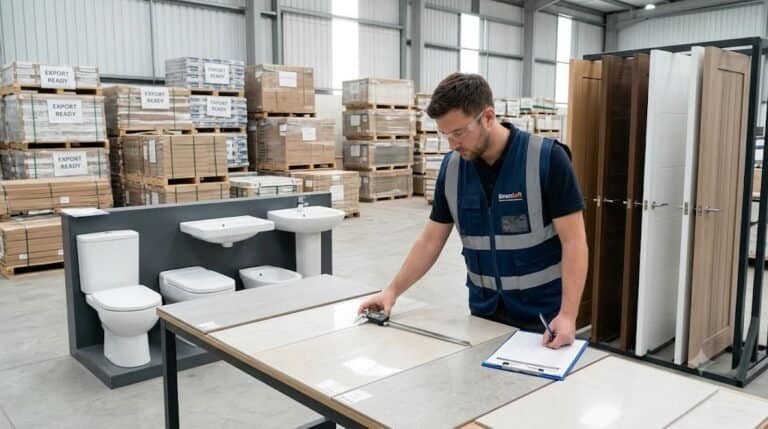
Piece by piece inspection, also called 100% inspection, full inspection or sorting inspection, is a quality check where every unit of a finished order is examined against an agreed specification and defect standard. Each unit is accepted, sent for rework or rejected. It replaces AQL sampling, which judges a whole lot from a small sample, and it is used when a single defective unit would cause real damage on site.
Use it when one bad piece costs more than the inspection: custom items, hotel room sets, finishes that must match, and any lot that has already failed a spot check.
Sampling vs 100%
Piece by Piece Inspection vs Pre-Shipment Inspection
A standard pre-shipment inspection pulls a random sample and decides whether the whole lot passes. That works when units are interchangeable and a few defects can be absorbed. Construction projects are different. A hotel needs identical vanity sets for every room, a tile floor needs one continuous shade, and a replacement unit has to be remade, shipped and cleared through customs again.
| Factor | AQL sampling (pre-shipment inspection) | Piece by piece inspection |
|---|---|---|
| What is checked | A random sample drawn from the packed lot | Every unit in the lot |
| Decision | Pass, hold or reject for the whole lot | Accept, rework or reject for each unit |
| Defects left in the shipped lot | Defects within the agreed AQL limit can still ship | Only what falls below the defect standard or is missed by the inspector |
| Time on site | Short and fixed by sample size | Grows with the number of units |
| Cost | Lower | Higher, scales with quantity |
| Best for | Standard items from a proven supplier | Custom, high-value, matched sets, failed lots, first orders |
Sampling plans follow ISO 2859-1 (ANSI/ASQ Z1.4). See how they work in our quality inspection in China service.
When It Pays
When Piece by Piece Inspection Is Worth the Cost
Full inspection costs more than sampling. It earns that cost in six situations we see on construction orders.
The Lot Already Failed a Spot Check
Re-sampling after rework only proves the average again. Sorting every unit separates good stock from bad so the good units can ship on schedule.
Finishes That Must Match
Tile shade and size grade, marble vein pattern, cabinet door colour, powder-coat colour across window frames. One off-tone piece shows on a finished wall or floor and cannot be hidden.
Hotel and Room-Set Projects
Every room needs the same complete set. A short or damaged set means an unfinished room on opening day. See hotel and resort FF&E procurement from China.
Custom and Made-to-Order Items
Special sizes, finishes and project profiles cannot be replaced from stock. A rejected unit means a new production run and a new shipping cycle.
Small Quantities of Costly Material
When a batch is limited and each unit is expensive, a sample tells you little. Feature stone, large-format glass and imported-grade sanitary ware fit here.
A New Supplier or First Production Run
Before you scale, check the first lot unit by unit. Pair it with a factory audit and verification of the manufacturer.
When It Is Not Worth It
Standard catalogue items from a factory with a clean inspection history do not need 100% checks. Use AQL sampling and spend the difference on during-production checks.
Hybrid Plan
Choose the Inspection Level by BOQ Line, Not by Order
A BOQ mixes cheap bulk lines with items that can stall a site. Inspecting everything unit by unit wastes money. Sampling everything leaves the critical lines exposed. We tier each BOQ line, then apply the matching method, from least control to most.
- Level 1
Factory Self-Check
Factory team only. No independent eyes on the goods before they leave.
- Level 2
AQL Pre-Shipment Inspection
Random sample from the packed lot, one pass, hold or reject decision for the whole lot.
- Level 3
During Production + AQL
Catch drift while units are being made, then sample the finished lot.
- Level 4
Piece by Piece Inspection
Every unit graded accept, rework or reject. The most control, the highest cost per unit.
| Tier | Typical BOQ lines | Method |
|---|---|---|
| A. Critical or matched | Sanitary sets per room, feature stone, custom doors and windows, curtain-wall glass panels, anything with a long replacement cycle | Piece by piece inspection, every unit |
| B. Standard, repeat | Standard tiles from a proven factory, fittings, hardware, lighting of a tested model | AQL sampling per ISO 2859-1 plus a during-production check |
| C. Bulk, low value | Fixings, consumables, accessories easy to replace locally | Document and packing check, quantity count |
Example tiers. Final tiering is agreed per project when we review your BOQ and specification.
What We Check
What We Check Piece by Piece, by Material Category
Every brief is written from your order, drawings and approved sample. The table shows what is typically checked on each unit. Dimensions, tolerances and the applicable standard are fixed in the inspection brief before the visit, for example ISO 13006 for ceramic tiles or EN 12150 for thermally toughened glass.
| Category | Checked on every unit | Sorting output |
|---|---|---|
| Flooring and tiles | Surface defects, warpage, edge chipping, size grade and shade code against the approved sample, box count and labelling | Units grouped by shade and size grade so each area is laid from one grade |
| Stone and marble | Slab number and sequence, vein and colour match to sample, cracks, resin repair, finish, thickness and size | Slabs numbered and packed in sequence for matching on site |
| Bathroom and sanitary ware | Glaze pinholes, hairline cracks, warpage, fit of fittings, flush and drain hardware, set completeness | Complete, clean sets only are packed. Marked pieces go to rework or replacement |
| Doors and windows | Frame size and diagonal, corner joints, powder-coat finish, glass scratches, gasket fit, hardware operation, set completeness | Operation-tested units packed with hardware matched to the frame |
| Glass systems | Edge chips, scratches, bow, thickness, marking and labelling against the order, breakage before packing | Panels cleared one by one and racked with edge protection |
| Steel structure | Member length and straightness, weld appearance, coating condition, hole positions, marking against the drawing | Members marked and bundled by assembly |
| Kitchen cabinets and wardrobes | Carcass squareness, edge banding, panel colour match, door and drawer alignment, hardware operation, set completeness | Cabinets packed by kitchen or room set |
| Electrical and lighting | Function test of each unit, labelling, plug and polarity, finish, packaging | Tested units sealed with unit-level marking |
Related: the quality control checklist for tiles, sanitary ware and doors.
Process
How JEES Runs a Piece by Piece Inspection
The inspection runs at the factory, or at an agreed sorting location when units from several factories are checked before consolidation. It runs on orders we sourced and on orders you placed directly with a factory.
- Step 01
Brief Written From Your Order
BOQ lines, drawings, approved sample and applicable standard. Critical, major and minor defects are defined in writing, with an accept, rework or reject rule for each.
- Step 02
Limit Samples Signed Off
An accepted, a borderline and a rejected sample are agreed so every inspector grades the same way on day one and day ten. See getting samples from Chinese factories.
- Step 03
Inspection Station Set Up
Daylight-balanced lighting, tables, gauges, measuring tools and a separate area for units that need rework, so graded stock never mixes.
- Step 04
Every Unit Examined
Dimension, finish, function and marking are checked against the brief. Each unit is marked accepted, rework or reject as it is graded.
- Step 05
Defect Log and Quarantine
Rejected units are separated and counted. Defects are recorded by class and photographed in context, so the report can be reviewed without being on site.
- Step 06
Rework and Re-Inspection
The factory repairs or replaces. Every reworked unit is inspected again, not just a sample of them, before it rejoins the accepted stock.
- Step 07
Repack and Seal
Accepted units go back into export packing to your specification, with cartons marked as inspected. See export packaging for building materials.
- Step 08
Report and Loading
Counts of accepted, reworked and rejected units, the defect log by class and the photo set. Add container loading supervision so the units that passed are the units loaded. How to read an inspection report.
Straight Talk
What 100% Inspection Can and Cannot Do
Break-even rule. Piece by piece inspection pays for itself when the expected defect rate multiplied by the cost of one defective unit on site is higher than the inspection cost per unit. Count replacement production, freight, customs, rework labour and the delay to the programme, not just the price of the unit.
It Does Not Guarantee Zero Defects
Inspection is done by people. Poor light, fatigue and a vague defect standard all cause missed defects. A written defect standard, limit samples and a re-inspection step matter more than the label 100%. Ask any provider how they control this.
It Finds Defects. It Does Not Fix the Cause
If the same defect keeps appearing, the problem is upstream. Pair it with a during-production check or a factory audit so the next lot arrives cleaner.
Timing Decides the Result
Schedule it when production is complete, so no unchecked units arrive after sorting ends. Inspecting early means units are produced later and go unchecked. Inspecting after packing means cartons are reopened and repacked.
Agree the Rejection Rules in the PO
Before production starts, write down who pays for sorting, who reworks, how fast replacements are made and what happens to the payment balance if the reject rate is above the agreed limit. Disputes start where the PO is silent.
Worked Scenario (Illustrative, Not a Client Case)
A hotel fit-out needs 150 identical sanitary sets, one for each guest bathroom. A spot check passes the lot, because defects below the AQL limit are allowed to ship. A handful of sets with glaze pinholes are still inside it. Each one is a finished bathroom that cannot be handed over until a replacement is made, shipped and cleared. Piece by piece inspection finds those sets at the factory, while rework or replacement is still a factory job and not a new shipping cycle.
Cost and Quote
What Piece by Piece Inspection Costs in China
There is no flat rate, because the work scales with the order. The price is driven by the number of units, the time each unit takes to check (a window with hardware takes longer than a floor tile), the number of defect classes and tests, the factory location, whether units must be repacked, and how fast you need it done. Compare it against the cost of one defective unit on site, not against the price of a sampling inspection.
What Moves the Price
Six Things That Set the Price
Number of units
Inspection time grows with every unit in the lot.
Time per unit
A window with hardware takes longer than a floor tile.
Defect classes and tests
Each extra test or defect class adds time to every unit.
Factory location
Travel to the factory or the agreed sorting site.
Repacking and relabelling
Reopening and resealing cartons adds labour after grading.
Turnaround you need
A tight loading date needs more inspectors on site.
Rule of thumb: compare the inspection cost with the cost of one defective unit on site, not with the price of a sampling inspection.
Quote Checklist
Send These for an Accurate Quote
- Quantity per BOQ line, and whether all units are finished and packed
- Drawings, specification or approved sample, and the standard to apply
- Which defects to check: one known issue or full conformity
- What happens to rejected units, and how long rework or replacement takes
- Whether accepted units must be repacked and relabelled
- Factory city and the date window before loading
Who It’s For
Who Uses Piece by Piece Inspection
The buyers who order it are the ones who cannot absorb a defective unit on site.
Developers and Contractors
Matched batches for each fit-out phase, so a rejected unit does not hold up a floor.
Importers and Distributors
Stock that does not come back as customer returns, and a defect record to use against the supplier.
Hotel and Resort Projects
Complete room sets, consistent finishes, units ready for installation on schedule.
Architects and Designers
Finish consistency held to the approved sample across the whole order.
Related Services
Related Inspection and Sourcing Services
Piece by piece inspection is one step in a quality plan. These services cover the steps before and after it.
AQL sampling before the balance is paid.
In-production and final checks.
Inspected goods, sealed container.
Check capability before you order.
If goods arrive damaged, short or wrong.
One BOQ, verified factories, one shipment.
FAQs
Piece by Piece Inspection in China: Your Questions Answered
Piece by piece inspection is a quality check where every unit of a finished order is examined against an agreed specification and defect standard. Each unit is accepted, sent for rework or rejected. It is done at the factory or at a sorting location in China before the goods are loaded for export.
Yes. Piece by piece inspection, 100% inspection and full inspection describe the same method: every unit is checked, not a sample. Sorting inspection usually refers to the same work when the goal is to separate defective units from good ones.
Pre-shipment inspection checks a random sample and gives a pass, hold or reject decision for the whole lot. Piece by piece inspection checks every unit and gives a decision for each one. Sampling is faster and cheaper. Piece by piece inspection leaves fewer defective units in the shipment.
Choose it when one defective unit causes real damage: custom or matched items, hotel room sets, costly materials in small quantities, a lot that already failed a spot check, or a first order from a new supplier. For standard items from a proven factory, AQL sampling is usually enough.
The cost depends on the number of units, the time needed per unit, the defect classes and tests in the brief, the factory location and the urgency. Send your BOQ lines, quantities and factory city and we quote against that scope.
At the supplier’s factory or warehouse, or at an agreed sorting location when units from several factories are checked before consolidation. The right place depends on quantity, factory space and how many suppliers are in the shipment.
No. It sharply reduces the number of defective units, but people do the checking and some defects can be missed. A written defect standard, limit samples and re-inspection of reworked units keep that risk low.
They are separated and logged by defect class. Depending on the defect and your PO terms, the factory reworks or replaces them, and every reworked unit is inspected again. Agree who pays for sorting and rework in the PO before production starts. If goods still arrive faulty, see how to make a claim.
Yes. A multi-factory order is treated as one inspection scope. Each factory is visited, each category is checked to its own method, and the results are merged into one report mapped to your PO lines before the consolidated shipment is loaded.
It depends on the number of units, the time each one takes and how many inspectors are assigned. We estimate the duration from your quantities and brief, and plan it to finish before the loading date.
Get a Sorting Quote
Send your BOQ lines, quantities, factory city and loading date. We confirm the inspection level for each line and quote against that scope.
Send Your BOQ
Check Every Unit Before It Leaves the Factory
Send your BOQ, drawings or material list with the factory city and loading date. We confirm the inspection level for each line and come back with a quotation. Sourcing the same order with us? The inspection plan is built into the sourcing.